The street
filled with tomatoes,
midday,
summer,
light is halved
like
a
tomato,
its juice
runs
through the streets.
In December,
unabated,
the tomato
invades
the kitchen,
it enters at lunchtime,
takes
its ease
on countertops,
among glasses,
butter dishes,
blue saltcellars.
It sheds
its own light,
benign majesty.
Unfortunately, we must
murder it:
the knife
sinks
into living flesh,
red
viscera
a cool
sun,
profound,
inexhaustible,
populates the salads
of Chile,
happily, it is wed
to the clear onion,
and to celebrate the union
we
pour
oil,
essential
child of the olive,
onto its halved hemispheres,
pepper
adds
its fragrance,
salt, its magnetism;
it is the wedding
of the day,
parsley
hoists
its flag,
potatoes
bubble vigorously,
the aroma
of the roast
knocks
at the door,
it’s time!
come on!
and, on
the table, at the midpoint
of summer,
the tomato,
star of earth, recurrent
and fertile
star,
displays
its convolutions,
its canals,
its remarkable amplitude
and abundance,
no pit,
no husk,
no leaves or thorns,
the tomato offers
its gift
of fiery color
and cool completeness.
– Pablo Neruda (1904 – 1973)

Interpretation of the poem
The poem “Ode to Tomatoes” is a poem composed by Pablo Neruda, a Chilean poet. This poem is written in free verse, which means there isn’t any regular meter or rhyme in the poem. And its form is unique as it is made up of several run-on lines which consist of only one to maximum of five words. Ode is a lyric poem that is written in praise of somebody or something, hence, as the title suggests, in this poem we see the tomato being praised for its appealing appearance, remarkable nature, and significant place among vegetables in Chilean dishes.
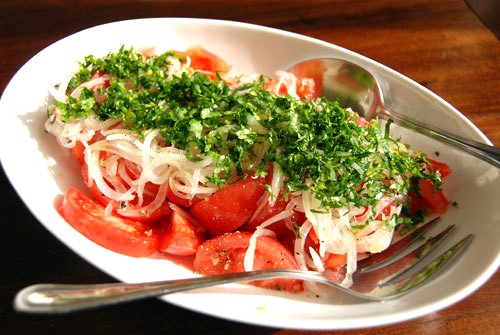
The poem talks about the tomato salad, which is a very important Chilean side dish. “The street filled with tomatoes” and “its juice runs through the streets” are the images for the abundance of tomatoes in the streets of Chile. “In December” suggests December is the seasonal month for tomotoes in Chile, and it is “summer” in December in Chile as the country lies in the southern hemisphere. December is also the festive month (Christmas time) when special meals are prepared and served accompanied by tomato salads.
The special feature of this poem is that in the making of the tomato salad, tomato has been personified. It ‘invades kitchen,’ ‘takes its ease on countertops’, ‘sheds its own light,’ and ‘we must murder it’ – as if tomato is a human enemy. But it is just a violent image suggesting the non-violent work of cutting tomatoes in the kitchen. The outer layer of tomato is called ‘living flesh’ and its interior is called ‘red viscera’. The personification continues explicitly. The tomato is ‘wed to onion’, suggesting that onion is the other equally important ingredient in the tomato salad. And the mixing or addition of other things to it like oil, pepper, salt, parsley, potatoes, and even roast is presented in the way of celebration of the wedding ceremony taking place. All ready, tomato thus in the form of salad appears majestically on the dining table and invites the people to taste it. The tomato is cut into circles that display its inner ‘convolutions and canals,’ and many are such circles that show its ‘abundance’ upon the plate. Moreover, the tomato has ‘no pit,’ ‘no husk,’ and ‘no leaves or thorns,’ – no such hindrance while eating, which makes it even more desirable or likeable. What it offers is ‘its gift of fiery [reddish and passion-filled] color and cool [pleasing] completeness [which makes the meal complete and satisfying]. Hence, the poem is ode to tomatoes that praises tomatoes for their tempting appearance, undeniable significance, and great generosity.
This poem can be subjected to post-colonial interpretation as well. When the poet talks about wedding of white onions and red tomatoes in the making of salad, he might be suggesting the intermixing of Spanish (the White) and Chilean (the Red Indians) as a result of colonization of Chile by Spain.
GLOSSARY
unabated (adj): without becoming any less strong
invade (v): to enter into a country or a town with military force in order to control it
saltcellar (n): small container for salt
benign (adj): kind and gentle
viscera (n): the large organs inside the body, e.g., heart, lungs
pepper (n): sweet and hot varieties of fruits of plants
hoist (v): to raise or pull something to a higher position
aroma (n): a pleasant, noticeable smell
vigorously (adv): energetically
convolution (n): a thing that is very complicated and difficult to follow, a twist or curve of many
amplitude (n): the greatest distance a wave, specially sound wave, vibrates
abundance (n): in great quantity
pit (n): the hard inner (usually woody) layer of the pericarp of some fruits (as peaches, plums, cherries or olives) that contains the seed
husk (n): outer membranous covering of some fruits or seeds
 Ramrowriter
Leave a comment