
Not a bird disturbs the air,
There is quiet everywhere;
Over plains and over woods
What a mighty stillness broods.
Even the grasshoppers keep
Where the coolest shadows sleep;
Even the busy ants are found
Resting in their pebbled mound;
Even the locust clingeth now
In silence to the barky bough:
And over hills and over plains
Quiet, vast and slumberous, reigns.
Only there’s a drowsy humming
From yon warm lagoon slow coming:
‘Tis the dragon-hornet-see!
All bedaubed resplendently
With yellow on a tawny ground
Each rich spot nor square nor round,
But rudely heart-shaped, as it were
The blurred and hasty impress there,
Of a vermeil-crusted seal
Dusted o’er with golden meal:
Only there’s a droning where
Yon bright beetle gleams the air
Gleams it in its droning flight
With a slanting track of light,
Till rising in the sunshine higher,
Its shards flame out like gems on fire.
Every other thing is still,
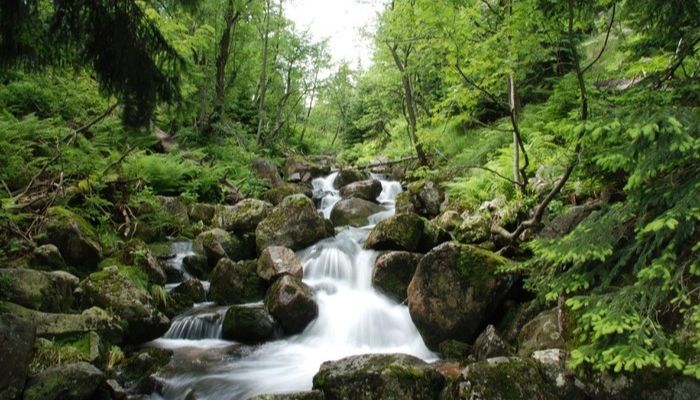
Save the ever wakeful rill,
Whose cool murmur only throws
A cooler comfort round repose;
Or some ripple in the sea
Of leafy boughs, where, lazily,
Tired Summer, in her forest bower
Turning with the noontide hour,
Heaves a slumberous breath, ere she
Once more slumbers peacefully,
0 ’tis easeful here to lie
Hidden from Noon’s scorching eye,
In this grassy cool recess
Musing thus of quietness.
– Charles Harper (1813-1868)
- Composed by Charles Harpur (1813-1868), an Australian poet
- rhyming pattern aabbcc…
- Describes one mid-summer noontime in the Australian forest
- Everywhere and everything is quiet except hornet, beetle, and a murmuring stream.
- Summer at noontime sleeps in the forest, and so does the poet feel sleepy and finds a comfortable place to sleep.
- The poet lies in shade upon a grassy place and muses on the quiet environment of the noontime.
Summary of the Poem
This poem is composed by Charles Harpur (1813-1868), an Australian poet. He describes the experience of one mid-summer noontime in the Australian forest. Everywhere there is quiet in the forest as the wild lives are sleeping at this slumberous time of the day. Even the grasshoppers, ants and locusts rest in silence. The only sounds being heard are those of hornet, beetle and a murmuring stream, and these sounds are of drowsing kind. The poet feels that the tired summer at this noontide hour sleeps with a slumberous breath, and so he also feels sleepy and lies comfortably in shade upon a grassy place musing on the quiet environment of this noontime.
GLOSSARY:
mound: a small natural hill
barky: having bark = tough protective covering of the woody stems of trees
slumberous: marked by drowsiness
drowsy: half asleep
humming: like singing with closed lips
lagoon: a body of water cut off from a larger body by a reef of sand or coral
hornet: large stinging paper wasp
bedaubed: ornamented in a showy fashion
resplendently: in an impressively beautiful manner
tawny: of a light brown to brownish orange color
vermeil: the color of vermilion – a bright, beautiful red
crust: outer hard layer
seal: an official mark of authenticity
droning: making a monotonous low dull sound
beetle: insect having biting mouthparts and front wings modified to form horny covers overlying the membranous rear wings
shard: a broken piece of a brittle artifact
rill: a small stream
murmur: a low, continuous sound of a stream
repose: freedom from activity (work, strain or responsibility)
bower: an attractive dwelling or retreat
scorching: hot and dry enough to burn or parch a surface
recess: a pause from doing something (as work)
musing: think deeply about something


 Ramrowriter
Leave a comment